




Scorsese and DiCaprio
The trio talk the movies, working together, the movies, Max Von Sydow, and the movies.
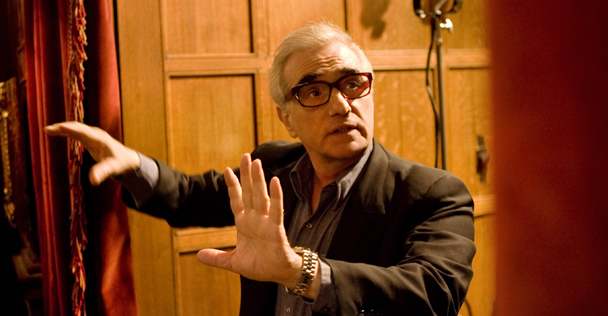
Scorsese, Leonardo DiCaprio, and Ben Kingsley on the movies, on working together, on the movies, on Max Von Sydow, and on the movies.
‘What’s up buddy?’ Leonardo DiCaprio says as Martin Scorsese takes a seat next to him. Like two no-nonsense, affectionate old friends.
‘What’s that?’ Scorsese says, pointing at two bottles of water waiting on the table.
‘Mineral water?’ DiCaprio offers.
‘Mmm.’ Scorsese looks mildly troubled. I wonder if DeNiro ever called Scorsese buddy. ‘The sparkling gets to me…I used to like it, but…you know…’
Scorsese and DiCaprio have just completed there fourth film together; a cascading psychological thriller called Shutter Island that is a throwback to the cascading psychological thrillers of the 1950s. DiCaprio plays Teddy Daniels as a US Marshall sent to a gothic island prison for the criminally insane to solve the mystery of a patient who disappeared. Or so he thinks. The film also stars Mark Ruffalo as his partner, Chuck Aule, Max Von Sydow as the lurky ex-Nazi death camp doctor, Dr.Naehring, and Ben Kingsley—who is sitting on the other side of Scorsese—as the enigmatic head psychiatrist, Dr. Cawley.
Shutter Island was by all accounts an intense shoot. ‘Self-imposed suffering,’ DiCaprio darkly jokes. ‘It was the nature of the material. When I first read the book and the screenplay it was obviously a complex jigsaw puzzle and the line in which reality starts and dreams begin for Teddy’s past is very blurred. Throughout the entire course of the movie you learn about different facets of Teddy Daniels mind on Shutter Island. He’s learning the truth and it’s a truth about his past and it’s a traumatic truth. Ultimately we had to keep pushing these storylines further and further. In order to have one set of circumstances be believable we needed to push emotional extremes in another set of circumstances. So we found, I think, both of us found that we kept pushing Teddy to darker and darker places during the course of the film and it was…I think it was surprising for both of us at times, because when you read a screenplay there’s only so much you can delineate or extract from what’s written on the page. When you’re actually there and having to do some of the sequences that are in this movie, it really shocked us, I think. In all sincerity it was a very demanding role. This is maybe the most challenging one to date for me. Physically, yes, but emotionally, more so. But it gives me great excitement as well. We’re also very conscious, Sir Ben and myself and Marty, that we were doing a film that would have a different interpretation the second time around, that could take on different meanings and there’s a certain level of ambiguity in the ending, and throughout the entire movie, that could lend an audience to have a different experience on further viewings. So that also challenged me as an actor in the way I portrayed Teddy because we’d be doing…how do I say this…pushing him to different extremes and it was then in the hands of Scorsese and Thelma [Schoonmaker, Scorsese’s long-time editor] to gauge what sort of extreme Teddy should go to and in which circumstance.’
‘I was rather shaken by all the green trees. I always am; it gets me. I’m allergic to. As a kid I used to love seeing westerns cause you could see the outdoors, but I had asthma, I couldn’t go anywhere. So I’d go to the movies. They were in Technicolor and you’d see the cowboys and you’d see landscape, Monument Valley, and then you’d see forests in the Anthony Mann films, and wow, it’s fantastic! But I can never go in there. Seriously. But we did it, we did it on this thing. Actually I was rock-climbing at one point, at seven in the morning, which was quite unique. But in any event the colour of the leaves disturbed me and so we had to work on that. On the other hand I didn’t want to drench it on a kind of depressing tone. For me the key image is the boat coming through the fog at the beginning. That’s something I imagined and liked. I guess there are references in other films I’ve made in a similar type of image but I think it’s interesting. It’s breaking through the mystery or maybe it stays in the fog, we don’t really know. Where is he [Teddy Daniels] at the beginning of the film? Who is he? There are a lot of good questions there but I think Richardson [Bob, the cinematographer] really, really was remarkable and Dante [Ferretti, the production designer] worked very, very well with the existing place that we had, Medfield, which was an old hospital for the criminally insane that had been pretty much abandoned at this point. The creation of the island, or the impression of the island as the island changes in the mind of the character, also came into play in another very important collaborator, Bob Legato, on special visual effects. And then ultimately there’s Thelma Schoonmaker who keeps me focused in the editing of the picture. Robbie Robertson was the other one that I called upon, for the music. As much as I admire film scores, and you know how much I’ve collected every film score, and Bernard Hermann I was lucky to work with, and extremely lucky to work with Elmer Bernstein, and Howard Shore over the years, but I’ve always imagined films with my own score. Because I don’t come from that world, I don’t come from that period of filmmaking, and so how could I make up my own score on a film like this where it isn’t necessary made up of popular music from the period? We were discussing it and thought ‘What if we came up with our own score?’ Let’s at least try as an experiment. And so Robbie Robertson came up with this idea of modern symphonic music with me. He started sending me CDs of different pieces of music. I mentioned Venusburg music by Wagner, and Charles Ives of course. But they were still part of an older world. We went further with Ingram Marshall, John Adams, Morton Feldman, Penderecki, Legeti. We just went on and on like that but the second batch is when I started to fit it in and ultimately synch pieces of music to different pieces of action, then actually rework all the music and mix it all together in different ways to make a score. And that went on for eight months or so.’
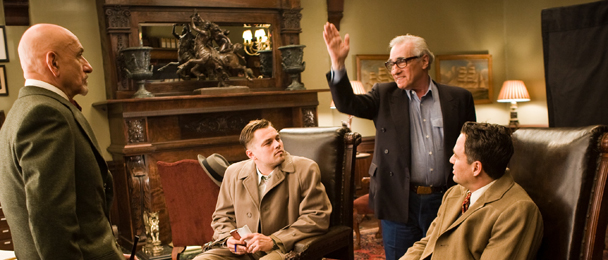
Kingsley, DiCaprio, Scorsese and Ruffalo on the set of Shutter Island
I was amazed at how elegantly these men spoke in complete paragraphs. Ben Kingsley turns to Scorsese and prompted him. ‘What about the fog horn, in the fog?
‘Oh, the foghorns in the beginning of the film!’ Scorsese becomes excited, ‘It’s Ingrid Marshall. It’s really something called ‘Fog Tropes’. That’s all brass. That’s an actual piece of music. It’s almost like a humpback whale in a way. But it’s all music. I mean then we use it again later, too. Fog Tropes.’
Being Scorsese, the preparatory work for the film was decidedly cineastic. ‘The first film I showed Leo and Mark Ruffalo and Sir Ben was Laura, Otto Preminger’s film, in the sense of the war-torn, war-ravaged hero. World-weary, so to speak; the body language of Dana Andrews, a man who falls in love with a ghost. The way he moved through the frame, the shoulders were down, he never looked anybody in the eye. And that wonderful scene where he just takes over her apartment, loosens his tie, makes himself a drink, and looks at the portrait and the doorbell rings (laughs). Then I showed Out of the Past, Jacques Tourneur. The trap, the puzzle, the mystery, the beauty, the poetry of that film. And Tourneur’s work on Cat People and I Walked With A Zombie, too, but primarily Out of The Past and Laura, Let There Be Light, John Huston, Battle of San Pietro. The Steel Helmet we showed, the nature of the soldier. And many others, for points of reference.’ Like the work of Sam Fuller? ‘Sam Fuller, Shock Corridor, can only be conjured as a mantra. Because Shock Corridor is a classic work of art. It comes from the unique experience of being Sam Fuller. Yes, there’s always that element of Shock Corridor hovering around the picture but never explicitly. In fact we didn’t even screen it. Because it’s in us. It’s in me, anyway. It was a way of conjuring up support by just saying the name Shock Corridor as we were going in to shoot. Or Sam. Sam Fuller.’
Scorsese takes a breath. Or maybe I take a breath. What about Hitchcock?
‘Vertigo is probably my favourite Hitchcock film,’ Scorsese says, renewed, ‘and one of my very favourite films of all time. It’s a film that I’m obsessed with. I saw it on it’s first release, projected in Vistavision, at the Capital Theatre in New York. That moment a nun comes up at the end? It’s just an extraordinary shock. But the entire film, even though I didn’t fully understand it—I was 15—at the time, but it was a film I kept revisiting. And it was of course taken out of distribution, shown only at LACMA in L.A. in the mid-70s. Everybody flocked to it. Brian DePalma, Spielberg, all of us went to see it. It was a Hitchcock retrospective and that was the only way you could see the picture. Except on TV, with commercials, and sequences cut out. But in any event it was a film that I …it’s one of those ones that I live with, and whenever it’s on Turner Classic Movies I watch it. I happen to have a beautiful Technicolor print of it. 35mm. It’s just beginning to go vinegar but you can still screen it. So you can see the real colour. I kind of helped support the restoration of the picture, beautifully done by Bob Harris. And, so, it’s very important. The musical score if very important. I’ve done concerts with John Williams, concerts of Bernard Hermann’s music. I introduce each section on Psycho, or North By Northwest, or Vertigo…to sit on the stage and be enveloped by the love theme from Vertigo is just an experience, to be enveloped by the instruments, to be taken into that vortex, and into the dream state of this obsession. That something that is the very basis of cinema. And life. Stewart’s performance in that film is an ultimate performance, particularly as he realizes in the last fifteen minutes of the picture what’s going on, and that gesture of his when he loses her a second time. It’s just an extraordinary thing. So I didn’t have to see the film again.’ He turns to DiCaprio. ‘Did I ask you to see it?’
‘No,’ DiCaprio says, ‘I saw that one on my own.’
‘I’ve screened it for a number of people over the years, many times, and screened it recently. Like Out of the Past or I Walk With A Zombie, or Cat People, Vertigo’s another one where I know the ending, I know the beginning, kind of, but I don’t really know where I am every time I see the picture. In other words I can’t tell you, “that’s directly the centre of the film.” I sort of let it take me every time. So if a film surprises you or a story or an atmosphere or an actor does something…you constantly think it’s new. I guess it’s me, I don’t know. I find it inseparable from what I do.’
With a film so highly steeped in historical cinematic knowledge, the weight working with Max Von Sydow was not lost on the actors. ‘It was incredible working with Max,’ DiCaprio says, ‘I mean, the sequence that I have where I sort of interrogate him or he interrogates me—depends on which way you look at it—it was only the back of his head that you had to see and his voice bellowing through that armchair and you just felt a chill down your spine. He has such a comfort level in the way he performs and that can only come from years of unbelievable work and such a belief in the power of what he does. It was chilling to work with him. He is part of cinema’s history and should be revered as that, and respected as that. He is a genius.’
‘He has absolute authority on the set,’ Kingsley adds, I hesitate to say authoritively, ‘and I’ve said this before and I know the chaps agree, that we can be chatting with Max on the set, engaged in wonderful conversation with him, and Mr. Scorsese will say action and you cannot see the difference between him being and him acting. Even inches from him. It’s an extraordinary quality. From his Bergman years onwards, layer upon layer upon layer of…perhaps not being added but being removed, peeled away from him so there’s something essential about him. Elemental. Very inspiring to work with.’
Scorsese picks it up. ‘Obviously we talk about cinema history, because he made cinema history, along with Bergman, of course, and the other filmmakers he worked with. But he is one of those figures in cinema history that sort of transcends the films that he’s in. He becomes in and of himself Max Von Sydow: it’s not just Max from the Seventh Seal or Max doing a small part in Wild Strawberries, or The Magician or The Face, or The Exorcist or any of the later films—even Needful Things; he plays a wonderful character in Needful Things. It’s simply this extraordinary presence. It’s literally as Sir Ben says, something where you strip away, and you can’t tell the difference with him.’
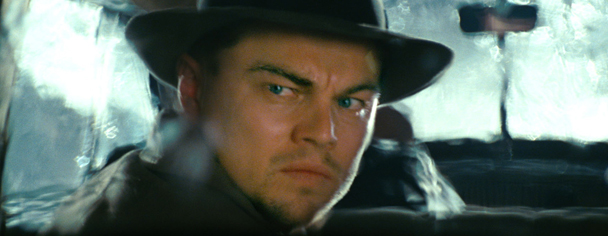
Leonardo DiCaprio as Teddy Daniels in Shutter Island
Was the film, a dark film, a dark experience? DiCaprio shifts. ‘For one reason or another, yes, I have to say, particularly on this film, there was a sombre mood going home every day. There were quite emotional extremes, and you know, it is the nature of the character dealing with extreme emotional trauma, his history, and it’s hard for those types of things to not rub off on you. But for the most part I do like to isolate myself away from most people when I’m filming for months at a time. So I wouldn’t necessarily get much of a reaction from anyone else cause I was mostly alone. Certainly towards the end of filming or during some of the end sequences, you know, there was sort of a lapse of understanding where I was, because we kept pushing this guy further and further and it was day after day of re-enacting a traumatic event that was either a dream or that was either reality for this guy. I remember saying to Marty, “I have no idea where I am. What am I doing now? what’s going on?” He’d say, “Don’t worry. Just do the scene again, do the take again, take it one more time, and keep pushing it.” And you know it’s great to have a guide or a mentor, somebody that you do trust in situations like that. Because you are making yourself vulnerable and you need to have somebody there that will ultimately guide you as an actor, and your character in the editing room. Through the relationship, through the years that we’ve worked together, that trust level was there, and I’m glad I got to do this character, and this film, very specifically with Marty as the filmmaker.’
Is Scorsese the greatest living director. Scorsese himself demures. ‘All I can do is to try to do the best work I can. I need to work, I like to work. Although I complain about it, I do like it, and I just need to make the best film I can. I mean, it would be nice in a way if a film is recognized, but once you’re in the thick of battle, you just try to get through it and try to make something of it that you feel you can say, “yes, I directed that film” years from now, if I’m around, and be happy with it. And so you try your best. Sometimes you go in with one thought in mind, and one desire—in the case of Aviator to make a Hollywood spectacle—but quickly, like the second or third week of shooting, you want to survive it; you want to literally survive it. I also go through the editing process, too. And, of course, when the film is released we have to talk about it. So I take it very seriously.’
Kingsley leans forward, ‘Could I as an outsider make an observation about this wonderful relationship? Because as another member of the cast observing this great longevity of a working relationship, they never for a second excluded…every debate on the set between Martin and Leonardo was shared. There is no shorthand, there is no whispering in corners, every single person on the set gets the benefit of this working relationship, so that it has, it’s continually refreshed. You don’t feel that it’s a private language. It’s the language of the film, and we were all part of that debate, which I think, given the history of the relationship is quite generous and remarkable. It really lifted the whole set, the way they were together on the set.’


COMMENTS