




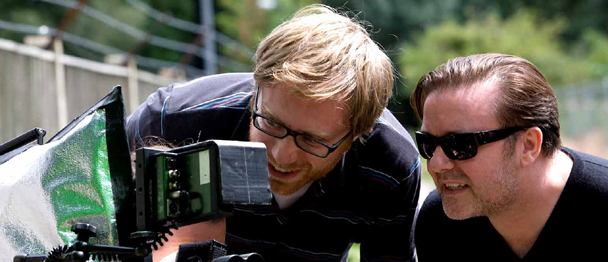
Ricky Gervais and Stephen Merchant
The duo talk about family, Karl Pilkington and Cemetery Junction.
Of all the opportunities you must have had to make a film together, of all the stories you could have told, what was the appeal of Cemetery Junction?
Ricky Gervais: I suppose we’ve always wanted to do something more autobiographical. Everything we’ve done is semi-autobiographical – working in an office, or working our way into television like in Extras – but there’s nothing quite as close to you as your forming years, and Cemetery Junction is about our memories of childhood. We also wanted to leave that veil of irony behind which broke us with The Office. In The Office it is the things that are crap which are funny; bad jokes were the funny bits and the awkwardness of it all. Cemetery Junction is more down the line: we follow these kids and it is a glorious summer and youth is to be celebrated with all its foibles and stupidities. We wanted to sort of come clean a little bit I think.
Stephen Merchant: Yeah, we wanted it to be a little bit more sincere. But I think there are still traces of what we do comedy-wise in there. There are similar themes to what we have done before: work and the people you surround yourself with, family and friends and where you’re going in life.
You mentioned that the film is inspired by your memories of childhood, and in many ways Cemetery Junction is a classic coming-of-age tale. What were the films that influenced you when you were growing up?
RG: I suppose the most obvious films were the kitchen sink dramas and things like Saturday Night and Sunday Morning and TV stuff like Cathy Come Home. Personally I’m quite influenced by people like Mike Leigh and Jack Rosenthal. All very British things. But I actually think the biggest influence for this particular film was more American stuff like Rebel Without a Cause and Cool Hand Luke and Saturday Night Fever and those sorts of things.
SM: And The Apartment, that’s been an influence on everything we’ve done pretty much.
RG: Yeah, it’s such a sweet, clever comedy about real people. I’ve always loved realism. I love fantasy too, but nothing excites me more than that ordinary tale.
What is it about ordinary tales that endears you to them?
SM: I think it’s the idea of taking small lives and making them feel a bit more epic. You think of things like Saturday Night Fever being slightly kitsch now, because of the white suit and the disco dancing, but actually it’s quite a gritty film in its own way. I mean, he’s a loser essentially.
RG: But no one’s laughing at him. No one’s going “oh, I get it, he works in a paint shop and lives for the weekends”. They’re going: “I wish I could dance like that!” And that’s what we tried to do with the character Bruce in this film. We didn’t want the film to be too gritty, we didn’t want it to be “ooh, isn’t England crap”. We wanted it to be a bit more glorious. It’s an ordinary tale, but there’s also an element of fantasy in order to evoke those fake childhood memories of every day being sunny and fun like I remember my childhood.
So would you say Cemetery Junction follows more in the tradition of American movies rather than British ones?
SM: British films are often very self-conscious and self-deprecating; we seem to need to make things gloomy and gritty. But that wasn’t my experience growing up. When I was a teenager, nightclubs seemed glorious to me.
RG: And your mates seemed cool.
SM: The toughest kid in my school was like James Dean to me. He carried a knife and everything.
RG: It was a butter knife.
SM: Yeah, give him something to spread and he’d be there like a shot.
RG: He wasn’t cool at all.
SM: No, but that’s the thing, because at the time he seemed cool to me.
RG: We don’t apologise for making it a little bit sunnier and prettier and quainter than it really was.
What was the appeal of setting Cemetery Junction in 1973, given that in real life you would have both been significantly younger than the protagonists of the story?
RG: Yeah, in 1973 I was 12 I think, and Stephen wasn’t born. But why did we set it in 1973? I don’t know.
SM: You don’t know? I’m sure you do.
RG: Not really.
SM: Yes you do. Let me explain. Part of it was the idea of romanticising the past.
RG: Yeah, I know that! But why 1973 specifically?
SM: Well, I was going to come on to that. Don’t get annoyed with me just because I’m giving a good answer and you gave a rubbish one.
RG: Did you know that Steve’s favourite artist is James Blunt? He loves him. He’s got a picture of him in his wallet and once I caught him… I’m not going to say, but he had to throw away the picture.
SM: Hey, Blunty is a good-looking lad. And he is a military man, so he can actually kill a man.
RG: Eventually. Over a period of many years!
SM: But seriously, we were talking about the fact that the 60s are thought of as a very revolutionary time in England, and then in the late 70s you get punk and stuff like that. But there seems to be a period in the early 70s when England became this sort of wilderness.
RG: Can I tell you how I remember it? About four years ago, I asked Elton John if I could use ‘Saturday Night’s Alright for Fighting’, because I’ve always wanted to start a film with it, and he said yes. I told Steve and he said “let’s set it in 1973 then”.
SM: No, because we talked about it for a while being 1971, remember?
RG: Is this interesting?
Fascinating. But maybe we should move on? There’s a lovely moment in the film when the main character, Freddie, announces that he wants to go travelling and his mum asks: “why do you want to do that for? There are parts of Reading you haven’t seen”. Was that the prevailing attitude when you were growing up, and how did you overcome it?
RG: That is a quote from my mum. It actually is! But I didn’t really have to overcome it. I suppose I always knew I would move away and do something else. It’s not that I felt particularly ambitious, it’s just that I had this biological clock in me: I turned 18 and then off I went. I was just inevitable. Also, I didn’t feel like I was trapped in a blue-collar working-class world. I grew up there and I loved it there. I had a great childhood and I loved school, but I always knew that something else would come next. I left without prejudice or resentment.
How have your family reacted to the film then?
RG: I don’t know, I haven’t spoken to any of them since I was 18. Fucking losers the lot of them! No, of course I see them all the time. But to them I’m not famous. They don’t think of me as an actor or anything.
SM: Not a lot of people do.
RG: They just think of me as the fat twat I always was.
The legendary Karl Pilkington has a short cameo in Cemetery Junction. How did he enjoy his acting experience?
RG: He arrived on set and I told the makeup people that I wanted him to look like a fucking twonk. I wanted him to have a wig, a bad moustache – the lot. I wanted to make him wish he’d never done this. So Karl comes out, looking like something from a Beastie Boys video, but he quite liked it because he was hidden and you couldn’t really tell it was him. But then, just before the take, the makeup guy took his wig off to adjust it and I thought, “fuck me, he looks like a baby bird!” So I took the wig off him and made him do it without the wig. It has to be one of my favourite scenes. He’s only in it for 2 seconds, but it’s one of my favourite things I’ve ever done.
Is he enjoying his filming for his new TV series An Idiot Abroad?
RG: No, he hates it, he absolutely hates it. He is never doing it again.
SM: We sent him to China, to India, to Mexico and to all these amazing places and he saw no redeeming value in anywhere he visited.
RG: He said: “I hate this, I’m never doing it again. I’m going to get a proper job.” So we thought a good second series would be him trying to get a proper job!
Read Pure Movies’ DVD/Blu-ray review of Cemetery Junction here.


COMMENTS