





La Grande Illusion and its journey to safety

 @garthtwa
 www.garthtwa.com
Garth Twa is the award-winning writer and director of 'Pieces of Dolores' and 'Birds Die'. He has also written episodes of 'The Wright Verdicts', a programme from the makers of 24 and CSI, and is the author of the acclaimed book 'Durable Beauty'.
![GRAD_ILLUSION_1[1]](https://www.puremovies.co.uk/wp-content/uploads/2012/04/GRAD_ILLUSION_11.jpg)
This year Studiocanal, in association with La Cinémathèque de Toulouse, is rereleasing Jean Renoir’s La Grande Illusion, easily—and for many reasons—one of the most important films in history. After years of painstaking work the film has been re-mastered in time for it’s 75th anniversary, and will not only have theatrical distribution but—for the first time—will be available on Blu-ray.
‘Studiocanal has a vast catalogue of classic world cinema, including many French, and also many English titles,’ Candy Vincent-Smith of Studiocanal says, ‘In the last few years we have embarked on a programme of restoring titles from this catalogue. There are two main reasons for this, firstly to be able to give some love and attention to what are very old materials in some cases, and thus to present the films, as much as possible, looking and sounding as fresh as they did when they were first released. Also, by creating digital masters of the films at the end of the restoration, we are able to ensure that we are able to preserve them for generations to come.’
This work cannot be underestimated. These classic films are not hoary texts, dusty and irrelevant. Movies give us our world, our past, make us who were are. They show us what is possible. ‘Film is history,’ Martin Scorsese has said. But, unlike any other medium, it is history alive.
A story of simple, elegant truth
La Grande Illusion is a war film without combat, without aggression, without villains; a war film without victory. It takes place in War World I, during the battle of Verdun, one of the bloodiest in history (between 700,00 and 1,000,000 people were killed), a fight that actually changed the gene pool in certain parts of Europe. When two French officers, Lieutenant Marechal (Jean Gabin), a mechanic, and Captain de Boeldieu (Pierre Fresnay), an aristocrat, are shot out of the sky they are taken to the quarters of the man who brought them down, Captain von Rauffenstein (Erich von Stroheim), who invites them to lunch. ‘Good to meet you,’ he says, ‘Too bad it’s here.’ War is still a gentleman’s game—they are not enemies, just opponents, just pawns in a game no one really wants to play. Von Rauffenstein even leads a prayer, a paean to the valor of the men that he has just killed in combat. Von Rauffenstein and de Boeldieu are both from the same class, a stratum with deeper roots and greater allegiances than mere—fluctuating—geopolitical boundaries; class trumps platoon.
Life isn’t so bad in the POW camp, where the two men meet another countryman, Rosenthal, a wealthy Jewish banker (to complete Renoir’s cross-section of French society). The prisoners tease the German guards, they have banquets with provisions from home sent to Rosenthal (Marcel Dalio), and they put on shows. We see kids playing like soldiers, and soldiers playing like kids. Battles are fought, lost, won, endless, fruitless, senseless. This is not an action film, and there is little suspense, just the monotony of a futile war dragging on: Fort Douaument is taken by the Germans, retaken by the French, then taken yet again by the Germans, solving nothing, signifying nothing.
They also dig a tunnel to escape, because that’s just the rules of the game: a camp is meant for escaping, ‘like a tennis court is meant for tennis.’ Before their tunnel is completed, however, Marechal and de Boeldieu are moved to a different POW camp, Wintersborn, a medieval fortress where they are reunited with von Rauffenstein, who claims the prison is escape proof. But again, just like in any sport, the French officers have to give it a try.
Eventually a plan is hatched, and de Boeldieu does as an officer must and aristocrat surely ought to, he plays a decoy, sacrificing himself so that Marechal and Rosenthal can escape. Von Rauffenstein shoots him, because he must, but not before pleading with him to return safely. ‘Damned nice of you, Rauffenstein, but impossible,’ de Boeldieu says then falls to ground at von Rauffenstein’s feet. Von Rauffenstein takes him back to his private suite. As de Boeldieu lays dying, von Rauffenstein is in aguish. ‘I bungled it. I aimed for the leg.’ De Boeldieu tries to comfort him, ‘But it was misty and I was running, so don’t feel bad.’ Both men know that it’s the death of far more than an individual; it is the end a world. They are artifacts, their class is an anachronism, and the time where they flourished is over, making way for a new country, a new world, for men like Marechal and Rosenthal. But how this new world will look is what La Grande Illusion concerns itself with.
Marechal and Rosenthal find refuge in a farmhouse where a German widow (Dita Parlo) takes them in. She lost both her husband and her brothers in the Battle of Verdun; there is savagery on all sides. She recognises something in the men, the humanity in the insanity and perhaps—as a species—there is hope for us all.
As the men run through a snowy hillside to safety, the German soldiers in pursuit stop firing when they think the men have crossed the border. ‘Is that Switzerland?’ one asks. ‘It all looks alike,’ another answers. The first sighs, ‘All the better for them.’ Unlike Hollywood, there are no faceless enemies and no side is worse than the other; Von Rauffenstein and the widow are in fact the most compassionate characters, next is the Jewish banker. The protagonists start off as combatants but are reduced, or elevated, to mere men. Polyglot, polyreligious, poly-class, La Grande Illusion is a call for compassion. It is ‘a story about human relationships,’ Renoir said, ‘I am confident that such a question is so important today that if we don’t solve it, we will just have to say “goodbye” to our beautiful world.’
The journey to safety
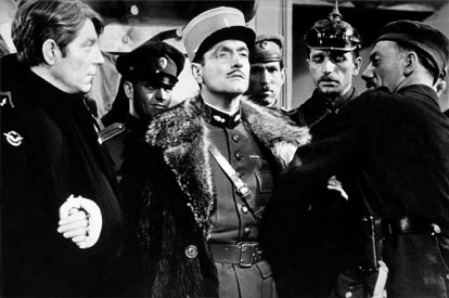
Renoir’s most personal film, one of the very few that he himself conceived, La Grande Illusion has had a long and treacherous journey. The film takes it’s title and philosophy from The Great Illusion, a 1910 book by Nobel prize-winning British journalist and politician Norman Angell who theorized that the cause of war is usually the pursuit of wealth, but that ultimately war is never of benefit economically and it therefore futile: ‘Are we to continue to struggle…spilling oceans of blood, wasting mountains of treasure…to achieve what is at bottom a logical absurdity, to accomplish something which, when accomplished, can avail us nothing?’ Renoir not only used his own experiences in the war—he had been severely wounded in WW I, shot down at Haut-Koeningsbourg castle, the location he uses in the film for Wintersborn, and Jean Gabin even wears Renoir’s old uniform—but he also interviewed members of League of Escaped War Prisoners. After struggling to get the film made for two years, he cast Gabin, a massive star in France at the time, and—bringing Gabin with him to production meetings—was able to secure the backing of distributors to get it made. It was a fait accompli when Erich von Stroheim stepped in to play von Rauffenstein, a character that didn’t even exist in the original script. To accommodate such a huge presence, Renoir combined two existing characters, changing the balance of the film (to the dismay of Gabin). Von Stroheim was a mythic beast—literally mythic, he made himself up—one of the masters of silent cinema and an uncompromising genius who, disgraced in Hollywood, was earning a living taking acting roles. Renoir was in awe, and indulged all of his eccentricities—in Hollywood von Stroheim was infamous for his perversities and excesses; he notoriously had the walls of his offices at Paramount covered in black leather—including giving von Stroheim his choice of accommodations in the castle during filming (he chose the chapel) and letting him create his character through accoutrements: a surgical collar, guns, riding whips, white gloves, and especially the iron girdle (a detail from a genius filmmaker, it captured, without exposition, the stricture and rigidity of von Rauffenstein’s class). The film took shape in shooting; Renoir claims he didn’t know how it was going to end until he’d almost finished all the exterior shots and had already started editing.
These classic films are not hoary texts, dusty and irrelevant. Movies give us our world, our past, make us who were are. They show us what is possible.
When the film opened, it was the only of Renoir’s films to was celebrated internationally on its release, honored at the Venice Film Festival and was the first foreign language film ever to be nominated for Best Picture at the Academy Awards. Unfortunately, the celebration was short-lived. Goebbels called it ‘Cinematographic Enemy Number One,’ and it was soon banned in Italy (its pacifism and appeasement were anathema to fascist ideals, although Mussolini kept the seized copy for himself and showed it to Italian filmmakers). Not long after it was banned in France (after charges of both being ‘Jewish propaganda’ and fears that it might demoralize the troops). When Paris was occupied in 1940, the Nazis seized the negative and shipped it to Berlin where it was held in the Reichfilmarchiv. Several years later, when Berlin fell, the Red Army appropriated select spoils of war, including works of art and reels of film from the German archive. These ‘Trophy Films,’ as the Soviets called them, included Renoir’s negative, which was taken to Moscow.
By this time, Renoir was exiled in the States (he’d been put on the Nazi extermination list—films certainly do have the power to change lives) and tried to reissue the film in 1946, but the Hollywood censors truncated the scenes with Dita Parlo (too risqué for an industry still in the grip of the Production Code), and any scenes that showed the Germans in a sympathetic light (the original charges of Jewish propaganda had been replaced by charges of German propaganda). Renoir would spend the rest of his life searching in vain to restore the original film. In the 1960s La Cinémathèque de Toulouse began collaboration with Gosfilmfond, the Russian National Film Archives, and the film was returned to France, though it remained unidentified in storage until the 1990s. The Cinémathèque, in league with Studiocanal, chose it to be the first film in their series of re-mastered landmarks of world cinema.
Does it really matter?
I was once loitering in the HMV at Piccadilly Circus. At the time I was teaching film studies at University. I ran into a former student. He was holding a DVD of La Grande Illusion (the inferior 1997 restoration), a film I had featured in the course. He spoke of the film in awe and sense of discovery; for him, it was a sacred object. Sometimes films can be our initiation in finding something greater in ourselves, like we’ve been admitted into a secret club. We all have those films, those films that open us up. La Grande Illusion is one of those films. It was for Orson Welles, and for Woody Allen. That’s what so important about what Studiocanal is doing. ‘With every foot of film lost, we lose a link to our culture, to the world around us, to each other, and to ourselves,’ Martin Scorsese says, ‘movies touch our hearts, and awaken our vision, and change the way we see things. They take us to other places. They open doors and minds. Movies are the memories of our lifetime. We need to keep them alive.’ In addition to restoring and re-releasing La Grande Illusion, this year Studiocanal are also bringing out Marcel Carné’s Quai des Brumes, Luis Bunuel’s deliciously nasty The Discreet Charm of the Bourgeoisie, and such Hammer classics as Dracula Prince of Darkness, Plague of the Zombies, The Reptile (though so far only La Grande Illusion is scheduled for a cinema release). They are also re-mastering Nicholas Nickleby, The Old Curiosity Shop, Woman in a Dressing Gown, and Passport to Pimlico. And that’s just the first year. ‘If either the original director or cinematographer is still alive, we try to involve them in the technical process of the restoration,’ says Candy Vincent-Smith, ‘and then if we can, cast and other crew. We also often ask scholars to be involved in terms of giving context, history and a critical appreciation.’
Watching La Grande Illusion now is like watching it a brand new film, and the brilliance of Renoir becomes dazzling. Stephen Hill, who works on the technical side at Studiocanal, says, ‘the last time we restored this title was 1997. This was a photochemical restoration using the original nitrate negative. Unfortunately we were limited by the technology of the time so the transfer would have been SD meaning that we lost a lot of detail in that transition from film to video. The other limitation was the type of restoration tools at our disposal.’ Now the technology has advanced and they’ve restored the original nitrate negative in 4K (widely regarded as the true resolution of 35mm film). Renoir’s virtuosic sound design (sound had only been around less than a decade) is also, for the first, able to be fully appreciated.
Why it’s just so damn good
Quite apart from the brilliance of the film’s story, and its performances, La Grande Illusion is a revolutionary milestone of visual art. Along with cinematographer Christian Matras (who also did films with Jean Cocteau and Max Ophuls) Renoir reworked the grammar of cinema. He perfected the use of the long single-take, the sequence shot, where entire scenes were shot unedited from a single cameral set-up. In one such shot, the camera starts from high outside, looking down onto the street. It pulls back, into a room, and we see Marechal. The camera then moves into a two-shot. A whole scene, with varied framing, in a single take. There is dramatic tension created by composing in depth, using various spatial planes for action and objects—requiring incredible deep-focus cinematography, and also a complex choreography of camera and action—effectively turning a 2-D screen into 3-D space. It hadn’t been many years before that the Pathé company, the leaders in production in France in the first decades of the 20th century, proscribed shooting any character less that full figure (as one would see it, say, from the 10th row center in a theatre) for fear that the audience would become confused, or assume they were watching a movie about dismemberment. To put it in perspective and understand Renoir’s achievement, 30 years ago we had Raiders of the Lost Ark, which still looks pretty modern. 30 years before La Grande Illusion, movies were 12 minutes long at best, silent, and had a chase scene. The close-up hadn’t even been invented yet, let alone the crane-dolly. According to Andre Bazin (the Noah Webster of film lexicon) Renoir ‘uncovered the secret of film form that would permit everything to be said without chopping the world up into little fragments, that would reveal the hidden meanings in people and things without disturbing the unity natural to them.’ This was done five years before Citizen Kane, often hailed as the greatest film (technically) of all time. But Renoir got there first.


COMMENTS